Tuesday, May 31, 2011

Mites are Monsters (1)

Budgies that are infected with mites can get scaly feet or a scaly face/beak.

In the case of a scaly beak, the crustiness can spread around the budgie's cere and eyes. The crusty, scaly appearance also appears on the legs and sometimes around the vent.

Untreated and sometimes even treated birds may develop permanent disfigurement in the case of a scaly beak and lameness in the case of scaly legs and feet. Serious complications usually occur that are not only extremely painful for the affected bird but often result in its death! This is a serious problem and you CAN'T leave it untreated!
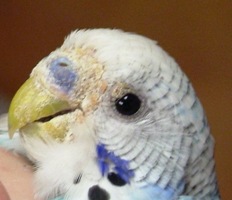

Image © azeah.com
How does it happen?

Scaly leg mites bore under the scales on the legs, grow bigger and infect your bird as quickly as they got there. Same story for the scaly face mites: they burrow in the skin, causing a powdery appearance. The beak may look white, chalky and crusty and will have a honeycomb appearance. The mites spend their entire life cycle on the bird, so you can't just get rid of them. The problem is that the mites eventually will be transmitted from bird to bird through prolonged close contact. Some experts say that the mites will cause an extra disease if the bird is genetically susceptible, stressed, or has a suppressed immune system.

Diagnosis

Different species of mites affect different species of birds. Knemidokoptes mutans (scaly leg mites) and Knemidokoptes pilae (scaly face mites/burrowing mites) are most frequently found in budgies.

The problem is that the infection remains latent for a long time so that your budgie may appear normal for most of the time. If you suspect that your budgie is suffering from parasital mites, you should be able to detect it by looking for scaly gray or white crusty lesions on the nonfeathered skin. Some kinds of mites cause severe itching and even feather loss.

The feet of a healthy budgie should be free of any encrustation or malformation. Image © The Budgie Cage
Transmission

Most of the parasite mites are transmitted mainly in the nest box during feeding; i.e. during direct body contact from parents unto the chicks. Special attention should also be paid to couples, because they are in close contact with each other. A mite infestation in a budgie occurs between its 6th and 12th month of life; thus often shortly after the bird has been bought. So it's something you have to watch out for from the very beginning.

Sunday, May 29, 2011

Lazy afternoon

Have you noticed how your budgie sometimes gets lazy after lunch time, or during a hot Summer afternoon?

Image © zearticles.com
This is normal behaviour. Budgies need a minimum of 12 hours sleep at night and fact is, most budgies don't get this required amount of sleep. They wake up from the morning light, or get woken up when their owner goes to work in the morning. Or they hear may hear a noise at night and sleep badly afterwards. Budgies try to catch up the lost sleep during the day by taking naps.
During hot Summer days, they often doze to save energy.

What you probably didn't know is that budgerigars adapt their sleeping pattern according to that of their owner. You'll often see them taking a nap when other people in the house are quiet :-)
If you decide to stay up late, please consider your budgie's health. Dim the tv noise and make sure it's dark enough so the budgies can sleep well.

Saturday, May 28, 2011

Migration habits of wild budgerigars

I found an excellent article on this online. I added some more information to it in order to make it more complete. Personally, I think this is one of the most interesting topics when it comes to the study of wild budgerigars.

Budgerigars in the U.S.

Wild budgerigars can also be found outside Australia. Image © Free-Extras.com
The wild budgerigar lives in Australia, primarily in desert areas such as scrub lands and grasslands. It can also be found in open, dry woodlands. Although budgerigars are not native to North America, some wild budgerigars can be found in American farmlands and on roadsides. These budgerigars were, or came from, domesticated birds that either escaped or were set free. Florida is one of the locations in the United States where wild, domesticated budgerigars can be found. Adaptations to their habitat by the budgerigars include being able to go without drinking for a month and not breeding if they are living in an area riddled with drought.

Picture © resivanzijl.blogspot.com
Note: domesticated budgies would not survive in Belgium, because the climate is too cold and wet for them during the Winter. Budgies thrive best in warm and dry Summers. But there is a record number (over 10,000) of wild ring necked parakeets settling around the capital city. Their natural habitat is in fact around Northern India, so they don't have a problem with our severe Winters.

Flock spirit

The basic colour of wild budgies is green. The many colour variations are a result of mutations in specific genes.
 Budgerigars are typically found in flocks, other known as chatters. Large flocks can be formed under favorable conditions, such as an abundance of food or breeding females. These flocks can number upwards of 5,000 to 10,000 birds. Flock movement is based on where food and water are available. Competition among budgerigars is typical in flocks for food, water, mates and nesting holes. But it will never come to a deadly conflict.

Flocks of budgerigars are known to withstand many hardships that other flock birds can't survive, such as brackish water, food shortages, extreme temperature changes and a large number of predators. The budgerigars found in wild flocks are strong, adaptive and intelligent, as opposed to the less adaptive birds that get sick and die easily in the extreme conditions in which they live. The most unlucky example of this is a blue budgie born in the wild.

Distance and direction

Budgerigars can fly up to 250 miles in a day to locate food and water. Budgerigars have such excellent eyesight they can sense rainstorms up to 40 miles away. This helps them migrate to areas that have a better potential for water and feeding grounds. Budgerigars typically migrate over vast distances and often in the correct direction, as they always seem to go "straight" to a waterhole or a food source.

Image © gdaywa.com
Opposite of birds in the Americas, Budgerigars in their natural habitat of Australia migrate in a north to south pattern. This means that budgerigar flocks typically fly south in the spring and stay through the summer. In turn, budgerigars fly north in autumn and stay up north through the winter. The locations of migrating budgerigars, and the abundance of the flocks, vary from year to year. The north to south pattern of their migration makes it possible for budgerigars to take advantage of seasonal aridity and rainfall of the inner-Australian region.

Tuesday, May 24, 2011

Erwin the budgie loves showering too!

If you read my last post about Erwin, the talking budgie from Australia, you may already know how adorable he is. The way he says "good night my baby" makes me feel warm inside ^_^

In this video, he is taking a shower and he's totally loving it. Most budgies want to take a bath every day!

Sunday, May 22, 2011

Grooming Rituals

Budgies are charming little birds and relatively easy to live with. Given proper care, they will pitch in by taking good care of themselves. A happy, healthy budgie will preen its feathers, bathe, clean its beak and tend to its nails.
Sick budgies will mostly sit around listlessly, without making a sound. Unhappy budgies may go as far as to completely neglect their grooming rituals.

Whether healthy or sick, you have to encourage your little bird to keep grooming itself every day!

Image © Волнистые попугайчики
  • Observe your budgie's grooming rituals. You should see it preening its feathers, using oil from a gland back near its tail. Other things they often do is scratching about on the bottom of the cage, and wiping their beak back and forth on the sitting perches. It's a very bad sign if you never see them doing this!
  • Place a shallow bowl of lukewarm water in the bottom of the cage or in the bird's living area a couple of times a week so that it can take a bath. Water is life! If your budgie is hesitant about bathing, try putting some leaves of lettuce in the bowl. Budgies love lettuce and will be attracted to the water.
  • Provide your budgie something to trim its beak on. Pet-supply stores offer items of this sort that attach to the side of the cage where your budgie can peck and scrape at it with its beak. Your budgie needs to keep its beak in shape so that it can preen its feathers properly.
  • Help your budgie with grooming by doing your part! In captivity, budgies are unable to keep their nails filed down sufficiently, so you will have to trim them from time to time. 
Image © ChrystyLande on Flickr
Two other good tips:
  • Feed your budgie a healthy diet. Supplement a small seed mix with fresh veggies. Like any other animal, a well-fed bird will better maintain healthy skin and coat.
  • Get your budgie a partner. Budgies are highly social birds, and one kept alone or with birds of other species may become depressed and stop caring for itself. If you observe budgie couples, you will notice how much they cuddle and groom eachother. It's very good to have another budgie to groom them, it keeps them happy and helathy!
Source: Ehow.com