Showing posts with label Australia. Show all posts

Sunday, February 5, 2012

First written reference to budgies (Europe)

Did you know that the first European to write anything about budgies was the English ornithologist John Gould?

Which reminds me of something: in primary school, I was already known for my love for birds. Right before I moved on to Secondary school, my teacher said to me: "You love birds, so maybe one day you could become an ornithologist. You should write down that word and remember it."

Anyway, John Gould sailed to Australia to study the birds of that country. The result of this trip was The Birds of Australia (1840 - 1848). His wife Elizabeth made hundreds of drawings from specimens for the publication of his work.

Photo © Katrina Morris

Gould not only named and described our budgerigars, but he is also credited with introducing them to Britain. He specifically mentions the "beautiful little Warbling Grass Parakeet", which, prior to 1838, was so rare in the southern parts of Australia that only a single example had been sent to Europe.

During his explorations, he explains that budgies were flying in flocks of up to a hundreds strong over the Liverpool plains. Describing these as "the most animated, cheerful little creatures you can possibly imagine", he managed to bring a live pair back to England. Gould apparently also commented on how good they are to eat (I do not approve of this at all!!!) - hence the Aboriginal name "Betcherrygah". "Budgerigar" is in fact a corrupted version of this Aboriginal name. In Dutch, on the other hand, we call them "Grass parakeets", which leans closer to Gould's version.

Wednesday, October 12, 2011

Leaves or wild budgies?

Photo © Paul Ross
As you can see, their feathers make them look like they're part of the tree. Anyone could think it's just the reflection of the sunlight on the leaves. Clever budgies!

Monday, September 19, 2011

Budgerigar Street

Wanna take a trip to Budgerigar Street?

Out of curiosity, I typed it in Google and found (not to my biggest surprise) that there is a Budgerigar Street in Australia:


Budgerigar Street is located in Green Valley, a suburb of Sydney. At first sight, the street is home to some brand new buildings and real estates. Wow!

Photo © homehound.com.au

Photo © fkyeahbirds
I'm just imagining real estates for budgies now... the little birds deserve it, as they live a life of hardship in the wild. But maybe they think it's even better to be free. Or would they like some caravan holidays?

Sunday, July 17, 2011

Birds in Australia (video)

Australia is home to over 50 different species of parrots.Wild budgerigars make a short appearance in this video. Look how graceful they are flying. Apparently budgies and zebra finches live in the same area in central Australia! They face many dangers (like the falcon in this video), but this is where they always lived... it's amazing!

Saturday, May 28, 2011

Migration habits of wild budgerigars

I found an excellent article on this online. I added some more information to it in order to make it more complete. Personally, I think this is one of the most interesting topics when it comes to the study of wild budgerigars.

Budgerigars in the U.S.

Wild budgerigars can also be found outside Australia. Image © Free-Extras.com
The wild budgerigar lives in Australia, primarily in desert areas such as scrub lands and grasslands. It can also be found in open, dry woodlands. Although budgerigars are not native to North America, some wild budgerigars can be found in American farmlands and on roadsides. These budgerigars were, or came from, domesticated birds that either escaped or were set free. Florida is one of the locations in the United States where wild, domesticated budgerigars can be found. Adaptations to their habitat by the budgerigars include being able to go without drinking for a month and not breeding if they are living in an area riddled with drought.

Picture © resivanzijl.blogspot.com
Note: domesticated budgies would not survive in Belgium, because the climate is too cold and wet for them during the Winter. Budgies thrive best in warm and dry Summers. But there is a record number (over 10,000) of wild ring necked parakeets settling around the capital city. Their natural habitat is in fact around Northern India, so they don't have a problem with our severe Winters.

Flock spirit

The basic colour of wild budgies is green. The many colour variations are a result of mutations in specific genes.
 Budgerigars are typically found in flocks, other known as chatters. Large flocks can be formed under favorable conditions, such as an abundance of food or breeding females. These flocks can number upwards of 5,000 to 10,000 birds. Flock movement is based on where food and water are available. Competition among budgerigars is typical in flocks for food, water, mates and nesting holes. But it will never come to a deadly conflict.

Flocks of budgerigars are known to withstand many hardships that other flock birds can't survive, such as brackish water, food shortages, extreme temperature changes and a large number of predators. The budgerigars found in wild flocks are strong, adaptive and intelligent, as opposed to the less adaptive birds that get sick and die easily in the extreme conditions in which they live. The most unlucky example of this is a blue budgie born in the wild.

Distance and direction

Budgerigars can fly up to 250 miles in a day to locate food and water. Budgerigars have such excellent eyesight they can sense rainstorms up to 40 miles away. This helps them migrate to areas that have a better potential for water and feeding grounds. Budgerigars typically migrate over vast distances and often in the correct direction, as they always seem to go "straight" to a waterhole or a food source.

Image © gdaywa.com
Opposite of birds in the Americas, Budgerigars in their natural habitat of Australia migrate in a north to south pattern. This means that budgerigar flocks typically fly south in the spring and stay through the summer. In turn, budgerigars fly north in autumn and stay up north through the winter. The locations of migrating budgerigars, and the abundance of the flocks, vary from year to year. The north to south pattern of their migration makes it possible for budgerigars to take advantage of seasonal aridity and rainfall of the inner-Australian region.

Sunday, April 10, 2011

Blue budgies in the wild: a sad story

From time to time, a blue budgie is born in the wild. So it is possible! And not just blue budgies either; reports during the 18th and 19th century indicate sightings of dark factor, possibly violet factor, opaline and albino budgies.

How does this happen?

Image © Alicia Guzmán Moya
Natural mutations occur just as frequently in the wild as in captivity. Also, there have been reports of escaped budgies in Australia that might have found their way to the wild flocks in and around the Outback. If one of these escaped budgies was a blue budgie, and if he was able to join a flock, he might have had enough time to start a nest with one of the wild budgies.

Do they survive?

No, almost never. The life-threatening circumstances and dangers of the wild can't make a new mutation viable, given that budgies with different appearances caused by mutations stand out and completely lose the protection of "blending in" with the rest of the flock.
They are singled out and killed by predators, as it is easier to keep them in sight.

No hope for blue budgies

Some budgies do stand a chance, though. It is not unusual to find opalines, cinnamon- and greywinged budgies in the wild. You will sometimes even find grey green budgies, as they don't seem to stand out like a blue or a pied budgie would. A flock of thousands of green birds with a blue bird in the middle easily catches the eye of predators, and the hawks head straight for them. On top of that, coloured budgies are often killed by other budgies because of the danger they pose to the rest of the flock.

Image © text.nu
Let's all pamper our sweet blue budgies today, make them feel at home where they are appreciated! Budgies in the wild have no choice but to reject them, for the sake of survival.

Tuesday, February 15, 2011

Budgies and their love for Eucalypt Trees

Eucalypt trees - also referred to as "gum trees" - have a special place in the life of the budgerigar.

The wild budgerigars in Australia have evolved alongside the Eucalypt tree and over all these thousands of years, they have developped an intimate bond with the tree and its leaves. Wet eucalypt leaves excite and invigorate both the wild and aviary budgerigar into a frenzy of joy. Does this sound familiar? Yes, budgerigars also start to sing when it's raining outside! It's an ancient instinct that tells them that the tide has turned in their favour.

How does Eucalypt help budgies?

Budgies love to bathe in wet Eucalypt leaves. It's healthy and refreshing for the little birds. Females in breeding mood chew the bark in search for trace elements and lysine, the breeding protein. Wild budgies also prefer the branches and trunks of Eucalypt trees to build their nests in. On top of that, the Eucalyptus oil from the leaves has some good medicinal properties that stimulate the immune system and promote a strong natural resistance to disease. The Eucalypt branches are also a personal favourite of the budgies for stripping and gnawing. And they love doing that!
This is why you should give the branches and the leaves to your budgie sometimes, it's their natural food and it's full of good things.

Important sidenote about your budgerigar's diet: Budgerigars are vegetarian and should not be supplied with meat, milk or other animal proteins. The birds' digestive systems are not able to properly digest such food, and these proteins tend to go off quickly.


Millet combined with fresh Eucalypt leaves: your budgie's dream dinner. Image ©budgierisa.webs.com

Images above (c) Wikipedia & The Telegraph

Information is copyright © 2000 Rob Marshall.

Sunday, January 23, 2011

Budgerigar Conservation in Australia

In 2000, 20% of Australian birds were listed as threatened. The most contributing factor is the on-going clearing of vegetation for the purpose of both agricultural and urban expansion. On top of this, Australia has to deal with climate change that increases the frequency of heatwaves and changes rainfall patterns.

Urbanisation in Australia always begins with a total clearing of the area. This leads to devastating results for the biodiversity.

Where do budgerigars play a part in this?


Budgerigars in Australia. Map (c) Birdata.com.au

As you can see, budgerigars are all over Australia. They cannot possibly escape what's happening, though at the moment their wildlife status is still secure. What threatens them most might not be urbanisation, but especially agricultural expansion in combination with climate changes. A more recent article on Australian bird conservation says that many birds that depend on the Australian network of wetlands are getting in trouble. Among those birds are budgerigars, who are often on the move in search for a new waterhole. Any undesirable changes through river regulation, water diversion, land clearing or salinity puts the life of the wetland birds in danger.


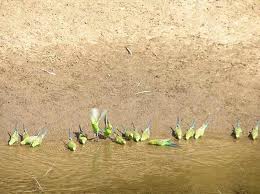
Budgerigars drinking at an isolated dam. Photo (c) the state of Australian birds, 2004

There are thousands of budgerigars living in the central part of Australia, where it's very hot. They already have to cope with a severe climate and would do anything for water. You don't need to imagine what happens when there is water shortage, for it has already happened in the past. When they finally find water, budgerigars go insane and all swoop down at the pool at the same time, being so thirsty that they accidently drown each other. A water-hungry venture such as agriculture only increases the risk of this horrible accident.

What can be done?
  • When planning new urban areas or agricultural expansion, large areas of land should be left intact. Wildlife corridors should be included in urban planning.
  • Every individual person can help, because it's also your responsibility. You have to be aware that not only in Australia, but pretty much everywhere in the world it's getting harder each day to maintain bird habitat and biodiversity. Plant and plan your garden so that birds can find their home there, when their other home is destroyed.
To read the latest report on the conservation status of Australian birds, go here (2010, Islands and Birds)

Saturday, December 18, 2010

A day in the life of a wild budgerigar

A nice summary of the behaviour of wild budgerigars, from the Encyclopedia of Life:

"Budgerigars aggregate into large flocks and are strongly social. Their grouping allows for greater success in feeding and also helps in protection from predators. There does not seem to be any hierarchy in groups based upon the relatively few battles among individuals, but females are generally more aggressive than males.

Their activity, like most birds, begins just before sunrise with preening, singing, and movement within trees. After sunrise, the birds fly to the foraging area and feed throughout the day. They do not forage during midday or in extremely hot weather, instead they take shelter under shade and remain motionless. At the end of the day, they congregate by calling loudly and flying at high speeds around the trees. They then return to their roosting site just after sunset and remain at rest until the next morning (Kavanau, 1987)."

Image (c) Karenstock on Flickr

Tuesday, November 30, 2010

Budgerigars are still Free

A lot of wild budgerigars still live in the Australian Outback, facing many dangers.


But they are free. Australia has banned the catching and trading of wild budgerigars in 1894.

Image (c) traveljournals.net

Wednesday, October 27, 2010

Out together, home together

Being part of a flock is very important to wild budgerigars.
If for example one bird takes off to drink, the whole flock will follow.

This is not just because budgerigars love to be together, but it also works as a precaution against possible enemies.

Image (c) tr1307 on flickr.com

Sunday, October 24, 2010

Budgies in Australia: discovery

Budgerigars have survived the harsh inland conditions of the Australian Outback for the last 5 million years. They were well known to the native aboriginal peoples of Australia, who used to catch the budgies for food and used their plumage for symbolic decorations. They already had a few names for the birds by the time colonists became familiar with them in the 1700s.

The English Zoologist Dr. George Kearsly Shaw (1751-1813) documented the existence of the species in 1794, but they were not yet able to make a good study on budgerigars, since they were still living in the wild. Shaw was the first to describe the small parrot, "the Australian Splendid Grass Parakeet", which he named "psitaccus undulatus" (undulated grass parakeet).
The English ornithologist John Gould (1804-1881) was clearly fascinated by these small birds, referring to them as the "most animated, cheerful little creatures you can possibly imagine".


Some extracts from Gould's masterpiece
Birds in Australia
So they still had dodo's back then? Wow... check out that nice picture of our sweet budgie buddies!

Gould was able to take a few budgerigars home with him. In 1840 he published the first detailed report on budgerigar behaviour in his work Birds of Australia. He was also the one who came up with the current scientific name, melopsitaccus undulatus ("melodious parrot", but also meaning "the best of all the grass parakeets"), in recognition of the birds' unique characteristics.

John Gould is mostly remembered because he was the one who imported the first live budgies to Britain during the same year, in 1840. Gould is also remembered as the enthusiastic ornithologist who described the famous finches of the Galapagos isles, in cooperation with Charles Darwin.

Five million years later, vast flocks of wild budgerigars still range across the deserts and dry grasslands of the Australion Outback. Fossiled bones found in Australia reveal that budgies have barely changed in the last four million years. This means they have been around far longer than the Aboriginal people, who arrived about 40,000 years ago, or any human beings at all!
If anyone knows the secrets and dangers of Australia, it's a budgerigar. These little birds are shaped by natural evolution, healthy, hardy, adaptable, tough and intelligent. They are capable of flying more than 400 km in a single day.

Fun facts:

Ever since Gould introduced the birds to Europe, they've become the world's most popular pet bird. Nowadays, it's illegal to export wild budgerigars from Australia. Don't confuse this with the so-called Budgie Smuggler meme, it has not much to do with real budgerigars - but more with a certain kind of swimwear:

http://www.budgysmuggler.com.au/
http://www.budgysmuggler.com.au/about/
http://www.urbandictionary.com/define.php?term=budgie%20smugglers

Wednesday, October 20, 2010

Australia: Homeland of Budgies (5)

One thing that is interesting to know about, is the breeding behaviour of wild budgerigars.
How can they stay alive with a high Summer temperature and an unpredictable low rainfall as an annual constant?

Budgerigars are nomadic birds. They will always move on to a better spot when times are hard. Another technique for them to stay alive in the dry Outback of Australia is by following thunderstorms. The smallest bit of water after a dry period can attract explosive numbers of budgies. When they run out of water, they have to move on until they find new water. Sometimes, a drought like this lasts several years. Whenever there's an opportunity, they have no choice but to take it.


Rainfall doesn't just mean salvation for the brave little yellow-green birds - it also marks the beginning of the breeding season. Rain means a brand new food supply - one that can feed enough beaks. Budgerigars have adapted to this unpredictable climate by activating their breeding cycle very quickly after the rain. They respond sexually to the good times, but when food supplies are limited by drought, they have no desire to mate and are unable to breed. In short - they're too busy surviving.

But even though rain is necessary, it's not going to decide completely whether the budgies will bring their breeding activity to a succesful conclusion.
Nature has got many seasonal, climatic, geographical and geological challenges in store for them. Taking this into account, the budgies will also have to keep their eyes peeled for danger. They're not the only animals who want to settle down in a fertile area after months of drought.


The soil in the upland areas of the Outback is more fertile than the reddish brown soil in the lowland areas. But the lowlands soil is rich in iron, and contains a lot of calcium in some parts. This calcium supply is a determining factor in the budgerigar's selection of nesting grounds. Calcium is necessary for egg production, which is a crucial part of the breeding cycle.
Beyond the lowlands, there lies a no-go place for budgies: the inhospitable sand deserts and barren plains.

There are Acacia shrubs dispersed throughout all of the lowlands, together with a diverse range of grasses. The grasses start to flower when there's enough rain, providing the famous grass seeds that budgies love so much. However, when it's really too dry, the grasses are completely useless as a food supply. The budgies are then forced to the dangerous sand deserts beyond the lowlands, where they are unable to breed. Desert vegetation that provide enough nutrients for the budgerigar's survival consist mostly of tussock grasses, Spinifex, Bandicoot Grass, Blue Bush and Salt Bush. This might keep the budgies alive for a good while, but the lack of rain and the absense of calcium-enriched soils make it impossible to breed.

Although not everything, the wet season determines a major part of the budgerigar's breeding cycle.
The starting time and duration of the wet season vary from year to year, partially depending on the monsoon activity further North and West of Australia.
The so-called El Niño and La Niña phenomena also have a major effect on the starting time and duration of the wet season.
An intense El Niño results in drought and often means death for some budgerigars. A normal El Niño results in monsoon activity in November, extending throughout the whole Summer (until April). The success of the budgies' breeding cycle is heavily dependant on both El Niño and La Niña - phenomena that appear to follow a 1500-2000 years long cycle. La Niña (or "anti- El Niño) is often followed by a strong El Niño. For the budgies, this is translated into: "Now we've survived the worst, it can only get better". La Niña causes mostly the opposite of El Niño, and since El Niño often causes a dry period, La Niña often brings salvation for the budgies: a wet period. When La Nina dominates the weather pattern, the number of budgies will rise again.

It's a combination of rainfall with moderate temperatures that makes breeding conditions as perfect as they can be. This way, breeding in the North isn't possible in the Summer, because of exterme temperatures. Similarly, temperatures are too cold in the South, even when there's enough rain.
During Winter months, budgerigars may fly to the North-East of Queensland where warmer temperatures allow breeding after the rain. The remaining seasons, especially Spring, are the most suitable times for the budgerigars to start their breeding cycle because of the moderate temperature.

In the Australian Outback, water is scarce and budgerigars must seek to find this in order to survive. About 80% of the desert waters come from thunderstorms. The thunderstorms are heavy and cause a flood, flowing down the slopes, into the dry riverbeds. These shallow rivers, waterholes, make an ideal nesting area for the budgies.

Finally, they found the perfect place to take a break from their nomadic life and start a family. They've earned it!


Information and pictures are (c) birds-online.de; pixdaus.com; sunnyhollowaviaries.com; birdhealth.com.au

Sunday, October 17, 2010

Australia: Homeland of Budgies (4)

In the wild, budgies build their nests in cavities and hollow tree trunks. They do this because the closed-in space makes them feel safe.
Domesticated budgies will also feel safer if you help them make a nest instead of giving them nest boxes.

Wild budgies prefer the branches and trunks of Eucalyptus trees to build their nests in. In these Eucalyptus trees, there are cavities in various sizes. The budgies will pick out the small cavities and make it their home, while larger birds like cockatiels will occupy the larger cavities.


This budgie is already excited to become a dad!

To find the perfect nesting areas, they have to find water. They aren't always lucky - sometimes their feeding grounds are 50 km away from the nesting areas.
The ideal place is of course a river bank: there's bound to be food and water around!

A creek is also a dream-home for a budgie: creeks are small streams, often shallow so the budgerigars can easily drink from it. And they love bathing! On top of that, it's probably bursting with food supplies during and after the rain season.

After the rain has come, budgies finally get ready to start a family of their own. They have to take advantage of the sudden big food supply, while it still lasts. The Australian Outback is known to be very hot and very dry and it often gives the budgies a hard time.
Each pair of budgies looks for a nice-looking little cavity in a hollow tree or log. The mother budgie lays four to six eggs and has to keep them warm for nearly three weeks.

In case the breeding cavity is too small, the female budgie can make more room with aid of her beak. Female budgies indeed have a harder bite than male budgies, because evolution made their jaw muscles stronger. So beware!

Father budgie isn't allowed to take a good look at the nest yet; his only task consists of bringing food to his mate and guarding the territory.
Once the baby budgies hatch, they're completely helpless, and remain that way for the next three weeks. When they start growing feathers, the father is allowed into the nest and helps to take care of his babies, so mother budgie can have a break every now and again.
Just a few weeks later, and the baby budgies are ready to spread their wings and join the big flock in their adventure of life. If the conditions are right - if there's still enough food and water around - Mom and Dad might start a new family right away.

The fact that budgies are colonial birds is yet another survival technique. When times are good, you can often see budgie couples bring up their babies at the same time, in the same eucalyptus trees. Nesting in colonies, as it's called, is an effective way to guarantee a maximum safety for each flock member. Many birds have a lot of eyes, and they're constantly watching the nesting grounds and the area surrounding it.

Budgies have different dialects that differ from flock to flock, but they will always understand each other when it comes to surviving. It is a certainty that budgerigars have a unified language, wherever they may come from. Otherwise they wouldn't be able to warn each other in case of danger. It goes as far as that budgies can even communicate certain information to other conspecifics (birds belonging to the same species). When there is danger, everyone needs to know.

Information and images (c) www.nwf.org; www.birdsonline.de; emucreekstation.com; kilcowerastation.wordpress.com; flickr.com

Sunday, October 10, 2010

Australia: Homeland of Budgies (2)

Wild budgies have no easy life. They live in Australia's "Outback", that's what they call the central part of the country, where there's little or no rain during the year.

Still, these birds have what it takes to survive in this barren place.
This is one of the reasons:


Appearance (I'm hereby referring to one of my earlier posts)

Potentially, there are about 20 million different possible colour combinations for aviary budgies. But the wild budgie is green. Any significant variation on this would make the bird stand out in the crowd, so it would become an easy target prey for hawks.

One more reason: they are absolute acrobats in the air. Although there can be over one thousand budgies in one flock, they will never collide. Wild budgies are quite small, slim and athletic. Their tiny form and athleticism make them difficult to catch.

Sunday, October 3, 2010

Australia, Homeland of Budgies (1)


Budgies are small, colourful birds that are native to Australia. They can be seen gathering in large flocks in the Australian wilderness, where they have survived harsch inland conditions for the last five million years.

In the following week(s), I'll gather information about how the little birds cope with different dangers in their homeland, how they adapt themselves to the wilderness, what they do, where they live, what they eat, where they sleep, etc.

I'll start with one first fact: budgerigars in their natural habitat in Australia, are noticeably smaller than pet budgies. They are 18 cm long and weigh 30-40 grams. English budgies can be one budgie-head bigger than their wild ancestors, and weigh up to 50 grams!

information: Wikipedia; http://www.birds-online.de/

Monday, September 6, 2010

Etymology

The budgerigar was named Melopsittacus undulatus by John Gould in 1840. John Gould was an English ornithologist who worked together with Darwin and did research in Australia. Gould noticed that the term Betcherrygah was used by the Natives of the Liverpool Plains.

The genus name Melopsittacus comes from Greek and means "melodious parrot". The species name undulatus is Latin for "undulated" or "stripe-patterned". So basically, budgies are little singing striped parrots :)


John Gould and his "warble grass parakeets"

There are several possible origins for the English name "budgerigar":

- A mispronunciation of the Gamilaaray gidjirrigaa, possibly influenced by the Aboriginal slang word budgery, which means "good to eat".

- A compound of the word budgery ("good") and gar ("cockatoo"). We already know why the Australian Aborigines gave the budgies that name - they used to eat them >:(

There's a range of alternative common names for our little budgies (most of them are Australian namings I think):

  • Shell Parrot/Parakeet

  • Warbling Grass Parakeet (Gould's common name for the birds)

  • Canary Parrot

  • Zebra Parrot

  • Flight Bird

  • Scallop Parrot

  • alternate spellings Budgerygah and Betcherrygah (Aboriginal name)

  • "love birds", because of their habit of mutual preening